Best Streets to Live in Durham: A Neighbourhood-by-Neighbourhood Guide
From Georgian Gilesgate and Hallgarth Street to the Victorian terraces of Western Hill and family homes in Neville's Cross, an honest guide to Durham's most liveable streets, student lets included.
Durham is a small city with a lot of character packed into its hills. Within a mile or so of the Cathedral you'll find Georgian streets, Victorian terraces, interwar semis and quiet cul-de-sacs, almost all of them within walking distance of the peninsula and the station. Choosing where to live here comes down to one question more than any other: how much do you want to share your street with students?
Durham University has more than 20,000 students, so many of the most central and characterful streets are dominated by shared student houses. That brings life, but also busy term-time evenings and quiet summers. Since 2016, Article 4 planning controls have covered almost all of the City of Durham parish. Under the County Durham Plan, a new house in multiple occupation (HMO) is normally refused where more than 10% of homes within 100 metres are already HMOs. That has slowed the spread of student lets, but it hasn't reversed it. Below we've been honest about where the balance currently lies.
We haven't quoted prices: values vary a lot street by street. For real figures, check HM Land Registry's price-paid data or the sold-price pages of the property portals. For a wider overview of the city, see our guide to moving to Durham.
Gilesgate
Gilesgate (the street) and around the green
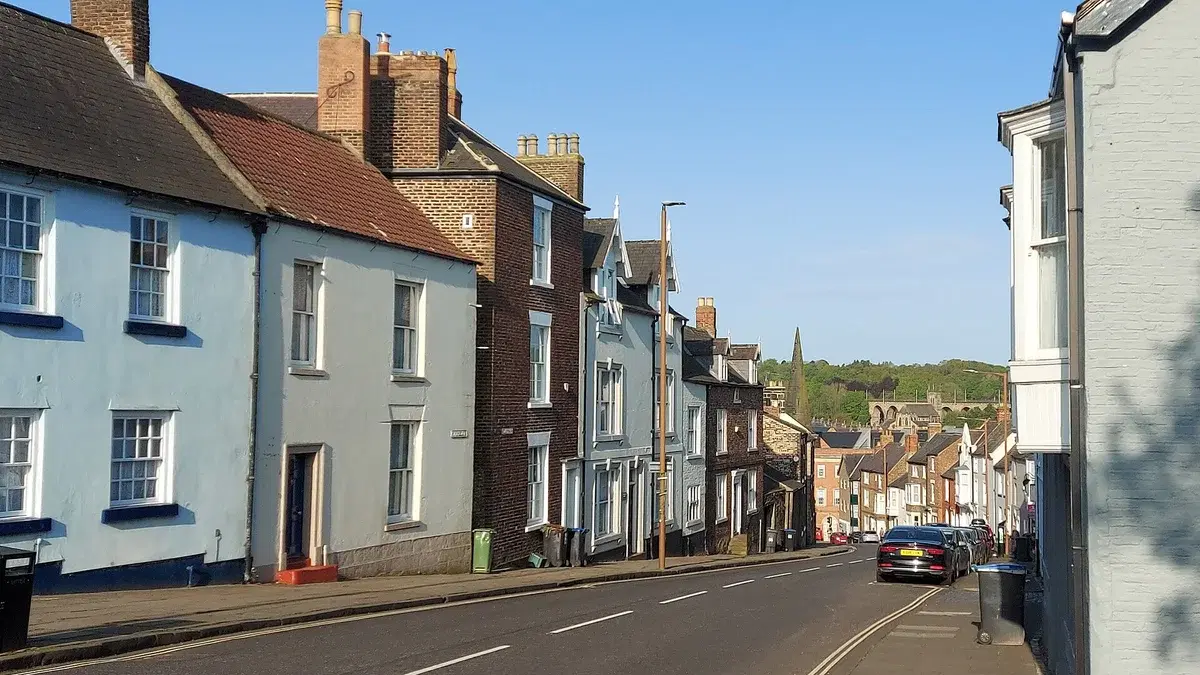
Gilesgate climbs east from the top of Claypath towards Gilesgate Moor and was once the main road into the city from the east. Its upper stretch, around the green and the Grade I listed St Giles' Church, feels like a village, with a run of listed Georgian houses. Behind it, 1930s and post-war streets offer semis and family homes at prices generally gentler than those closer to the centre. Durham Gilesgate Primary School was rated Good by Ofsted in 2023, and Belmont Community School is nearby for secondary.
The trade-off: Gilesgate is popular with students because it is a little cheaper and well served by buses, so some streets near the bottom of the bank are heavily student-let. Walk a street at 10pm on a term-time Friday before you commit.
Best for: Best for: period character and good value within walking distance of the centre
Elvet and Whinney Hill
Hallgarth Street
South of the river, Hallgarth Street is one of Durham's most attractive streets. It's lined with listed houses from the 17th to 19th centuries, including a long terrace from around 1840, and at No. 86 sits the Victoria Inn, a heritage pub. You're five minutes from Elvet Bridge, the Racecourse and the riverside, with the science site and the Botanic Garden up the hill to the south.
The trade-off: Elvet is one of the most student-heavy parts of the city, so expect a lively term-time atmosphere and plenty of letting boards.
Best for: Best for: historic townhouses a short walk from the river and the peninsula
Whinney Hill
Climbing above Hallgarth Street, Whinney Hill is a quieter street of 1930s and 1940s semis and terraces. With their gardens, these homes are a good fit for families. St Oswald's CofE Aided Primary, a small village-style school, serves the Elvet area. It's one of the best ways to live in Elvet without being in the thick of student life, although lets are present here too.
Best for: Best for: families who want Elvet's location with a bit more breathing space
Western Hill and the station side
Western Hill, The Avenue and Hawthorn Terrace
On the hillside above the railway station, Western Hill is one of Durham's more upmarket corners, with tall late-Victorian town houses, many with basements. Below it, The Avenue has handsome period terraces with sash windows and original fireplaces. Hawthorn Terrace lies in a conservation area and includes a Grade II listed group from about 1836. Wharton Park, with its famous view of the Cathedral and Castle, is on the doorstep (see our parks and gardens guide). The station is a few minutes' walk away, with direct trains on the East Coast Main Line to Newcastle, York, London and Edinburgh.
The trade-off: the neighbouring Viaduct area is one of the busiest student districts in the city, and that mix spills onto some of these streets. Parking can also be tight.
Best for: Best for: commuters who want period space and a short walk to the station
Neville's Cross and Crossgate Moor
Crossgate Peth and Neville's Cross
West of the centre, Neville's Cross is mainly residential, taking its name from the 1346 battle whose memorial cross stands beside Crossgate Peth. It has a mix of terraces and semi-detached homes on streets such as Nevilles Cross Villas and Cross View Terrace, plus a newsagent, pubs and a church. It's home to two well-regarded primaries: Neville's Cross Primary (rated Good in 2024) and St Margaret's CofE Primary on Crossgate Peth. Durham Johnston Comprehensive is just up the road at Crossgate Moor, which makes this one of the most sought-after areas for families.
The trade-off: Ustinov College's postgraduate community is based here, and some streets closer to the centre have a high share of lets. It's also uphill from almost everywhere, as Durham generally is.
Best for: Best for: families prioritising primary and secondary schools within walking distance
North of the river
Framwellgate Moor, Newton Hall and Pity Me
If you need more space for your money, the suburbs just north of the city are the practical choice. Framwellgate Moor grew as a mining village and now has its own Front Street shops. Newton Hall is a large, established estate of family homes, and Pity Me sits beside the Arnison Centre retail park. These areas are generally among the more affordable parts of DH1. Framwellgate School Durham serves the area for secondary, and the A167 gives quick road links north and south.
The trade-off: you lose the walk-everywhere charm of the centre. Most people drive or catch the bus into town, though it's a pleasant walk or cycle if you don't mind the hills.
Best for: Best for: family homes with gardens, parking and lower prices
Tips before you buy or rent
- Check the student balance. Visit in term time and look for letting boards and multiple wheelie bins.
- Check school admissions. Durham County Council publishes admissions criteria and past allocations. Our schools guide is a good starting point.
- Look at the hills. A street that looks close on the map can be a stiff climb with shopping bags. Live on a Durham street you think deserves a mention? Tell us about it and we'll consider it for the guide.
Never miss what’s on
Join the weekly Durhamcity.live digest — the best events, news and local tips, straight to your inbox. Free, one email a week.
What's On
Durham Market Hall History Tours
10:30 AM · Durham Market Hall, Market Place, Durham, DH1 3NJ
Tracy Borman: The Tudors on Tour
7:30 PM · Gala Theatre, Millennium Place, Durham, DH1 1WA
Durham City Walking History Tour
10:30 AM · Durham Market Place, Durham, DH1 3NJ