The Story of St Cuthbert and How Durham Began
Durham owes its existence to a saint. The story of St Cuthbert, the monks who carried his body, and the legend of the Dun Cow that founded the city.
Durham is one of the few cities in England that owes its very existence to a saint. Without St Cuthbert and the monks who carried his body across the North for more than a century, there would be no cathedral on the peninsula, and no city around it.
St Cuthbert of Lindisfarne
Cuthbert was born around 634 near the Scottish Borders and became one of the most revered figures of the early English church, prior and then Bishop of Lindisfarne before his death on the Farne Islands in 687. About eleven years after his burial his tomb was opened and his body was found undecayed, a sign taken as proof of holiness. His fame as a wonder-worker spread, and his shrine became a focus of devotion.
The long journey
When Viking raids made Lindisfarne unsafe, the monks abandoned the island in 875, carrying Cuthbert's body and their treasures, among them the Lindisfarne Gospels. For decades the community wandered, pausing at Chester-le-Street and elsewhere, before finally settling at Durham in 995, on the wooded peninsula in a loop of the River Wear where the city now stands.
The legend of the Dun Cow
Tradition, rather than firm history, tells how the monks found the spot. As the story goes, the cart carrying Cuthbert's coffin stopped and would not move, and a monk was told in a vision to take the body to a place called Dun Holm. Unsure where that was, the monks overheard a milkmaid searching for her lost dun, or brown, cow, last seen at Dun Holm, and followed her to the peninsula. The tale is remembered in a carved panel of a cow, milkmaid and monk on the cathedral's north-east wall, and in Dun Cow Lane beside it.
A place of pilgrimage
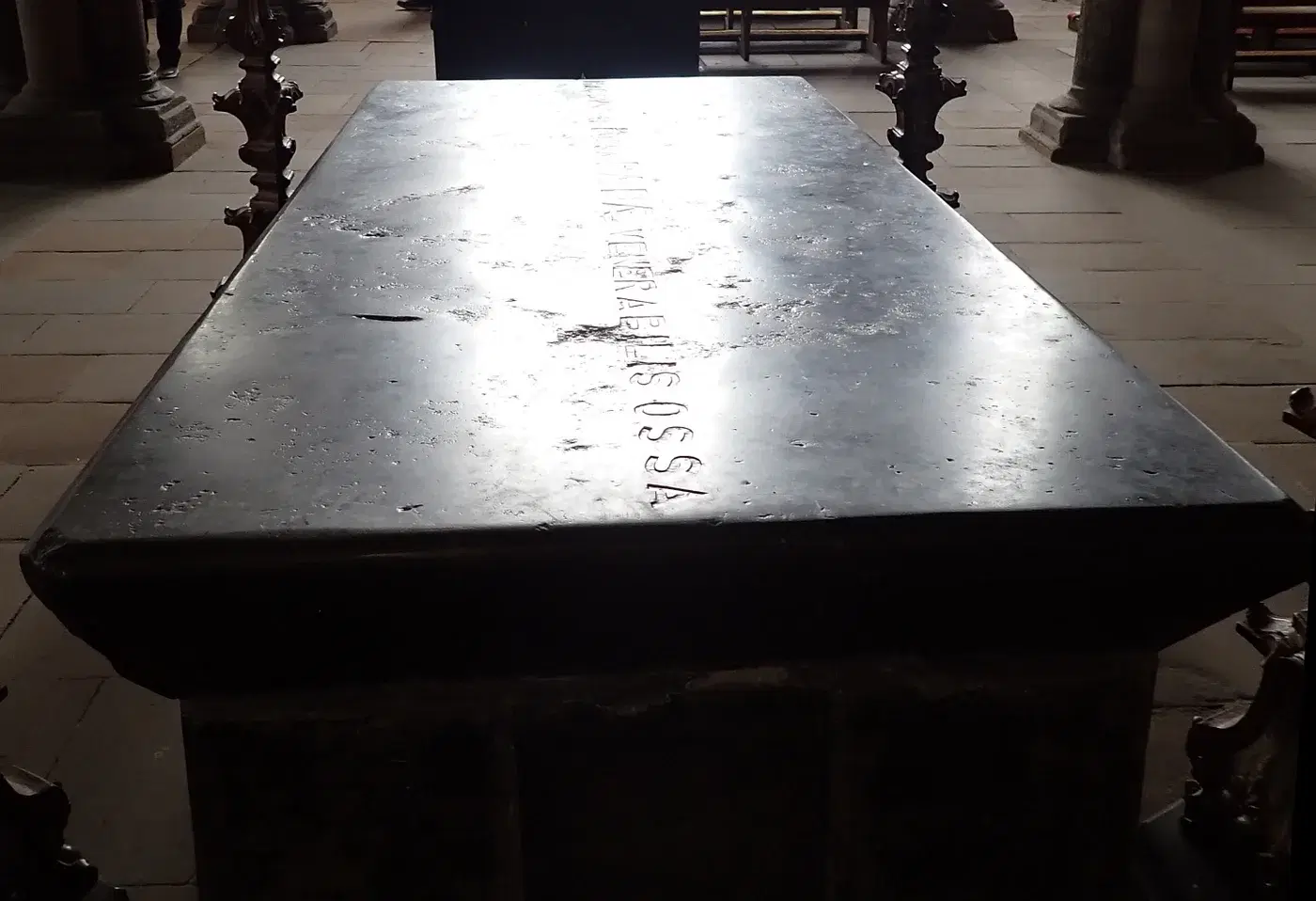
Cuthbert's shrine, moved into the new Norman cathedral in 1104, made Durham one of the great pilgrimage centres of medieval England. He does not rest alone: the bones of the Venerable Bede, the scholar who wrote the first history of the English people, were brought to Durham in the eleventh century and lie today in the Galilee Chapel, their slab inscribed simply, "In this grave are the bones of the Venerable Bede".
Local businesses mentioned
Never miss what’s on
Join the weekly Durhamcity.live digest — the best events, news and local tips, straight to your inbox. Free, one email a week.
What's On
John Kearns: Tilting At Windmills
7:30 PM · Gala Theatre, Millennium Place, Durham, DH1 1WA
Colpitts Poetry Live: Donald Jenkins and Patience Ezinwoke
7:00 PM - 9:30 PM · Redhills, Durham Miners' Hall, Flass Street, Durham, DH1 4BE
Durham Jazz Festival 2026
See booking, performance times vary · Venues across Durham city centre, including the Gala Theatre, Millennium Place, Durham, DH1 1WA